
If you find yourself with a spare hour and a half, and fancy doing something a bit more than doomscrolling, then I heartily recommend watching this recently released lecture that Grace Hopper gave at the NSA in 1982 on “Future Possibilities: Data, Hardware, Software, and People”.
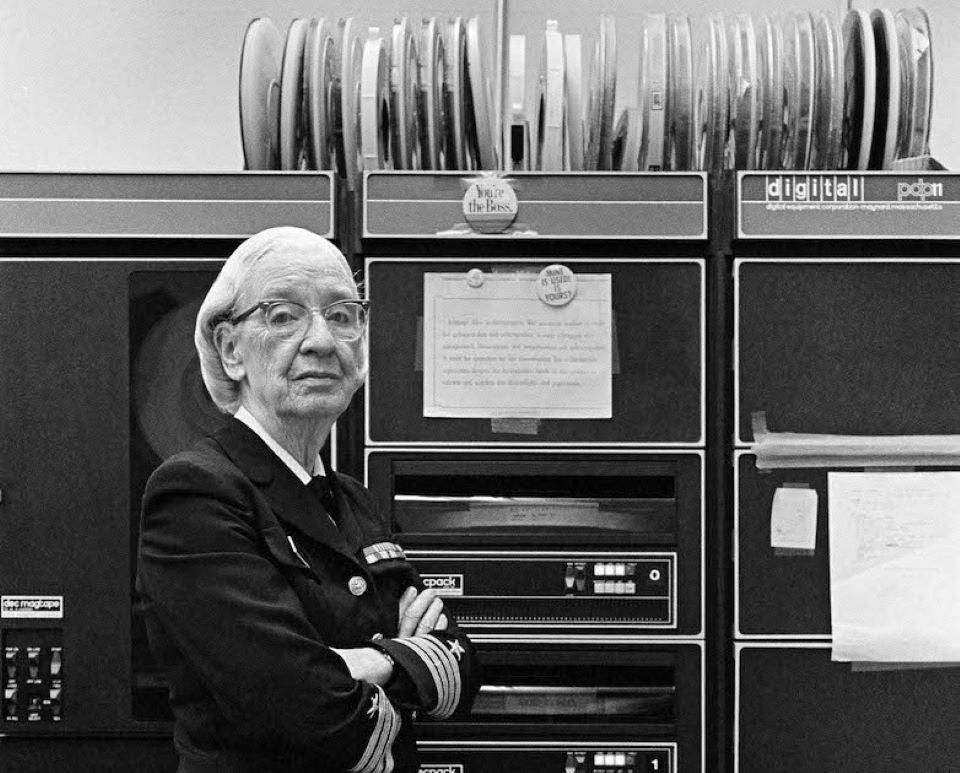
It’s a fascinating insight into a variety of subjects that Rear Admiral Hopper had an interest in, including computer network design, leadership, the length of a nanosecond, building for future requirements and so much more. It’s delivered with humour and obvious intelligence, it’s a window into how we thought about the future 42 years ago. It’s also interesting to see that we’re struggling with a many of the same issues today… the value of data for one.
If you’re not familiar with “Amazing Grace”— seriously, where have you been?— I strongly encourage you to learn more about her. She truly lived up to her legendary nickname.
Grace talked a fair bit about leadership in this lecture, and there were a couple of things that really resonate with me, I’ve highlighted them below.
…and we lost that concept of leadership. Loyalty up and loyalty down. It’s the one thing those youngsters are looking for. You can’t do it all by management. If I had a Marine standing here beside me, what he was say would be: ‘When the going gets rough, you cannot manage a man into combat. You must lead him.’ And I think he would further add: ‘you manage things. You lead people.’ We need people, we need to bring that back very badly, not only in the armed forces but in all of government, throughout business and industry.
I ran extracted the talk’s content using YouTube’s closed captions and then cleaned up the results using chat GPT. I’ve saved the result to Evernote, so I can refer back to it later, and I’ve shared it below so you can enjoy it too.
Transcript
There is a reason why I like that introduction. It’s because it gives me an opportunity to remind you that the first large-scale digital computer in the United States was a Navy computer, operated by Navy crew during World War Two. Recently, I’ve been finding that I have to remind people of that because there’s been a tendency on the part of a certain junior service to try and claim credit for those early computers, and they didn’t even exist yet.
Please remember that it was a Navy computer. If you’re wondering why I kept my cap on, I had a reason for that too. It’s because this is my identifier. I hope you all know by now that every record in a computer system must have an identifier. That’s so you know where to put it and how to get it again. There’s something odd about those identifiers, though; they have to be understood both by the person that originally puts it on the record and the person who later looks at the record.
That’s why my problem has been—I go wandering around airports and people come up to me and say, “When’s the next plane leave for Houston?”
I got totally demoted one night in San Francisco. I got off an elevator, and there was a couple in the elevator with me. As I got off, I heard the woman say to her husband, “What was that?” You’ve heard the worst of it, and he said, “That was a security guard.”
Then I went up to Canada to speak at the University of Guelph, and I had to go through immigration at the Toronto airport. So, I handed my passport to the immigration officer, and he looked at it and looked at me and said, “What are you?” And I said, “United States Navy.” He took a second real hard look at me, and then he said, “You must be the oldest one they’ve got.” You know, I didn’t really feel that was a polite way to welcome visitors to Canada.
But the only put-down I could think of was to say, “No, Admiral Rickover is six years older.” And I don’t think he even knew who Admiral Rickover was. But if you know what I am, I’ll take my cap off. That only goes to show my white hair.
Actually, I can remember when Riverside Drive in New York City, along the Hudson River, was a dirt road. On Sunday afternoons, as a family, we would go out and sit on the drive and watch all the beautiful horses and carriages go by. In a whole afternoon, there might be one car; cars were enormously expensive. They were individually built.
There was no such thing as gas stations. If you went on a long trip, you got five-gallon cans of gasoline, put them on the back deck, strapped them to the car, and took your gasoline with you. If you broke down in the middle of Utah, you wired back to the manufacturer, and then he sent a man out with a part, and he worked on the part until it fit your car.
And along came a gentleman named Henry Ford with two concepts: standard interchangeable parts and an assembly line. He started to build Model Ts. I think we’ve totally forgotten how tremendously that changed the world. You could have any color you wanted as long as it was black. They cost between three hundred and six hundred dollars, and people started to own cars. Naturally, once they had cars, they demanded roads; we built them. Gas stations appeared, garages were stocked with interchangeable parts, they appeared. People found they could move to suburbs and drive to work. And then, of course, they wanted to shop near home, so we had to build shopping centers. I think we’ve forgotten the tremendous developments that followed from the Model T Ford.
Now, whether you recognize it or not, the Model Ts of the computer industry are here. We’ve been through the preliminaries of the industry. We’re now at the beginning of what will be the largest industry in the United States, and I’m quite worried about something. When we built all those roads and the shopping centers and all the other things and provided for automobile transportation, we forgot something. We forgot transportation as a whole. We only looked at the automobiles. Because of that, today, when we need them again, the roadbeds, the railroads are falling apart.
If we wanted to move our tanks from the center of the country to the ports to ship them overseas, there are no flat cars left because we move all the cars on those racks on the roads now. If we wanted to move coal to replace oil, there probably aren’t enough hopper cars to move both the grain crop and the coal. The truth of the matter is we’ve done a lousy job of managing transportation as a whole.
Now, as we come to the world of the microcomputer, I think we’re going to be facing the same possibility. I’m afraid we will continue to buy pieces of hardware and then put programs on them when what we should be doing is looking at the underlying thing, which is the total flow of information to any organization, activity, company, or what have you. We should be looking at the information flow and then selecting the computers to implement that information flow.
Now, of course, if we do that, one of the first things we’ll need to know is something about the value of the information we’re processing. It’s close to eight years now that I’ve been trying to ask people how they value their information. I’ve gotten the finest assortment of blank stares you ever saw in your entire life. I even questioned whether there was a difference. Naively, I thought I could find out how people were evaluating their information if I could find out how priorities were assigned on the computer systems. Boy, did that go flat fast!
I found out exactly how the priorities are assigned. Top priority already goes to the senior squeaky wheel, not to the most valuable information. Some people even questioned that there was a difference in the value of information. I use as an example a chemical plant I know up in Michigan that’s totally operated by computer. Information comes in from marketing, goes through the computer; it opens valves, pushes stuff through pipes, tells inventory what it’s made; the people are paid by the computer; nice computerized reports go up to the president’s desk.
Now, let’s suppose that two pieces of information enter that flow simultaneously from two different parts of the system. One comes from a valve out in the plant and says, “If you don’t open me, the plant’s going to blow up. You have less than a minute in which to act; a hundred lives are at stake, hundred million dollar chemical plant.” At the same instant, in another part of the system, comes the fact that Joe did two hours of overtime. Which is the more valuable piece of information? And what are our criteria?
I’ve mentioned three possible criteria: the time in which we have to act, the number of lives affected, and the number of dollars affected. I think there’s a fourth: the importance of that piece of information in making decisions. No work, no research has been done on the value of information. We’ve completely failed to look at it, and yet it’s going to make a tremendous difference in how we run our computer systems of the future.
There are two things that are dead sure; I don’t even have to call them predictions. One is that the amount of data and the amount of information will continue to increase, and it’s more than linear. The other is that the demand for instant access to that information will increase. And those two are in conflict. We’ve got to know something about the value of the information being processed.
Everybody wants their information online. If one department gets an online system, then all the other departments want an online system. In many cases, that’s a matter of prestige, not of actual need. I played a very mean trick on one activity. I tacked a counter on every record. Every time the record was looked at, I added one. At the end of six months, I printed out everything that had not been looked at. One entire file fell out, yet the owner of that data had insisted that his information must be online. It was a matter of prestige to have his information online, not that he really needed it there.
One outfit has taken a second look at the data from that point of view—it’s the Coast Guard. They had a file which contained the complete history of every buoy. When a ship went out to maintain the buoys, they’d look in the file to see what had been done about the buoy over the last couple of years and whether any messages had been left to look at something next time. Those records started years ago, as a punch card and they’d gotten longer and longer and longer over the years. The whole system was slowing down, and yet they needed rapid access to it. So, they took a second look at those records, and they said, “Hey, we don’t need that whole record online. All we want online is the last couple of years. We don’t need to know when we bought the buoy and how much it cost unless we’re going in for a budget to get a new buoy. We can have that answer tomorrow or the next day.” They chopped those records. The front end of it that they need for reference to go out and maintain the buoy is online. The rest of the record is going back to batch, and you can have the answer tomorrow or the next day.
Somewhat the same thing has been done by Tactical Air Command at Langley. They were carrying online, for assignment on base, the complete record and history of every person. The whole system was slowing down because the records were so long. So they took a second look at the records and said, “Hey, we don’t need that whole record when we’re assigning a man on base. All we need to know is the last couple of schools he’s been to and the last couple of assignments he’s had. We don’t care where he went to high school.” So they trimmed the records. The immediate past history is online, and the rest is going back to batch. If he’s coming up for an award or promotion or something, you can have that tomorrow or the next day. They’ve begun to look at least at the time value of the information. There’s been no research in this area, there’s no one publishing papers, not even on the relative value of information within an organization. Nobody is looking at the value of information or comparative value of different pieces of information, and we’ve got to look at it because it’s cutting up our online systems. We’ve got to know more about the value of information in order to design the systems of the future.
I thought up a couple of curves. I have no numbers to put on them, and research hasn’t been done yet, but at least I think I can talk about the shape of them. Suppose this is dollars, and this is time. An event occurs here. Now, the value of the information about that event goes up quite sharply immediately after the event, but the further you get away from the event in time, the more the value of that information levels off. It goes up very sharply and then levels off. Ultimately, it either gets replaced by a new piece of information, or we decide we don’t need it online anymore, and we transfer it to historical files, microfilm, or something like that. Of course, in industry, they have to save it for the IRS, so the value curve probably looks something like that: a sharp rise, a leveling off, and then an eventual transfer to some form of historical file.
What about the cost of that information? The cost of information is very, very low at the time of the event, but the further you get away from the event in time, the more the cost you pile up to store, maintain it, and add any information to it. So the cost curve starts low and then zooms up. Now there’s a lovely crossover point there—that’s the point at which keeping that information in our online system is costing us more than it’s worth to us. But because we don’t know where that point is, we have no way of getting stuff out of our online systems, and that depends on knowing something of the value and the cost of the information concerned. We’ve got a big job to do in investigating those areas.
As a matter of fact, we don’t even know the possible cost of having incorrect information in a system. This vastly upset Lieutenant Colonel Randleman down at Maxwell Air Force Base, and he decided to investigate the possible cost of having incorrect information in the system. He found a section in the privacy law. Fortunately, most of our government employees don’t know it’s there or haven’t found it yet, which says that if you have incorrect information in a personnel file, and if because of it someone’s denied a promotion or a raise or something like that, they have a right to sue the federal government. It’s one of the very few cases in which the individual is directly given the right to sue the federal government, and it’s a very powerful paragraph.
“Whenever any agency fails to maintain any record concerning any individual with such accuracy, relevance, timeliness, and completeness—boy, that’s four powerful words!—as is necessary to assure fairness in any determination relating to the qualifications, character, rights, opportunities of, or benefits to the individual that may be made on the basis of such record, and consequently a determination is made which is adverse to the individual,” the individual may bring a civil action against the agency, and the District Courts of the United States shall have jurisdiction in the matters under the provisions of this subsection. So we decided to find out how much it might cost to have incorrect information in a personnel file. He said, “Let’s suppose I have a personnel file on 8,000 people. And further, let’s suppose that I know the file is 95% correct.” He selected things and looked at them and got a correctness percentage. Of course, I don’t believe there’s a personnel file in the country that’s 95% correct, but he said, “Let’s suppose it is,” and that means that 5% of those records contain incorrect information. Four hundred of them contain incorrect information. Then he went and talked to the decision-making people, and the psychologists, and so on, and he said, “What’s going to be the effect of that incorrect information?” They said, “Well, it’s going to stick out; it probably won’t match the rest of the file.”
Nobody takes any chances on anybody nowadays; we think in 90% of those cases, a negative decision will be taken on the basis of the incorrect information. That would mean in 360 cases, a negative decision is taken on the basis of incorrect information. Then he said, “We don’t know how many of those people will sue; we have no experience with that yet.” So, by the laws of probability, we’ll have to say it’s 50-50. One hundred eighty of them will sue the government. Now, of course, they’re bound to win their suit because the incorrect information is in the file. So he said, “Let’s suppose the damages are two thousand dollars.” I think he underestimated that—hundred dollars for court cost, six hundred and fifty for lawyers. Each of those cases is going to cost us two thousand seven hundred and fifty dollars. How much do we stand to lose because of incorrect information? Well, it turns out that 180 times 2750 is darn close to half a million dollars: $495,000, the possible cost of information in that personnel file. Now, until we make that computation of the possible cost of incorrect information, we can’t make a clear estimate of how much we are willing to spend to correct the file. I now know economically that I can go up to almost half a million dollars to get that file to a higher level of correctness because that’s what I stand to lose. We’ve almost never made any computation of the possible costs of incorrect information in the system.
One of the things that bothers me is we’ve talked about data processing for thirty years, we spend all our time talking about the processing hardware and software, and we paid no attention to the data. And yet the data is our raw material. Our output is information, our product. And we should be concentrating on the data in the information. The hardware and software are, after all, only the tools with which we do the processing and should not occupy the primary position in our thinking. It’s high time we began to turn our attention to the data and the information that we’re putting out. I don’t know how I’m going to persuade people to do it, but I’ll try hard.
There were a lot of things that were pushing me toward worrying about all this future business. We ran the Mark computers all during World War II. I thought you might like to know that the first computer bug is still in existence. We were building Mark II the summer of 1945. It was a hot summer in Cambridge, and naturally, since it was World War II, we were working in a World War I temporary building. Air conditioning wasn’t very good, no screens, and Mark II stops. We finally located the failing relay. It was one of the big signal relays, and inside the relay, beaten to death by the relay contacts, was a moth about this big. So the operator got a pair of tweezers and very carefully fished the moth out of the relay, put it in the logbook, put Scotch tape over it, and below it, he wrote, “First actual bug found.”
I know you’ll be glad to know that the bug is still in the logbook under the Scotch tape. It’s in the museum at the Naval Surface Weapons Center in Dahlgren, Virginia. I’ve told that story a lot of times. It turned out some people didn’t believe me, particularly the American Federation of Information Processing Societies. So, they made an expedition to Dahlgren, and sure enough, they found the first bug in the logbook under the Scotch tape, so they took a picture of it, and last year, in the July 1981 issue of the Annals of the History of Computers, they published a picture of the first bug.
And I think it’s rather nice that the Navy is keeping a few of the early artifacts like the first bug and me, and a few other things. However, it finally got to be 1946, and the war was over, and each one of us had to decide what we were going to do next. Now, up to that time, the WAVES had always been reservists, and in 1946, the Navy offered the opportunity to the WAVES to transfer to the regular Navy. So naturally, I applied for transfer to the regular Navy, and I was turned down because I was too old. The cut-off age was thirty-eight, and I was forty. Incidentally, it’s just as well to be told you’re too old when you’re forty because you go through the traumatic experience, and it never bothers you again after that. I really recommend it, highly.
However, I elected to remain in the reserves. Now, back in those days, in the reserves, we had three jobs to do: summer training duty, weekly meetings, and take correspondence courses. We had to take correspondence courses according to our designators— I was then an ordinance officer. At present, thanks to the now-defunct naval personnel, it turns out I’m an aeronautical engineer, but I don’t worry about that. So I took ordinance courses, and of course, the Navy was using up all the old manuals left at the end of the war, so I learned all about big guns and gun turrets and everything we were phasing out of the Navy, though it may come in handy again. I ran out of ordinance courses. The only other courses that would credit for my designator were war college courses, so, absolutely terrified, I sent for the first war college course, and they sent me the first problem.
I was to fuel a task force at sea in minimum time, and all they told me was how fast the different ships could pump oil and receive oil. And of course, I knew nothing about fueling ships at sea. But I had to do something, so I lined up an oiler and a carrier and started pumping from the oiler to the carrier. It was perfectly clear that wasn’t going to get me minimum time, so I decided they must have given me the rates for some reason. I looked at those and found I could simultaneously pump oil to the carrier and the carrier to a destroyer, and they’d both be filling up because the rates were different.
Now, somewhere along the line, somebody had given me a course in problem-solving, and they told me to always extend every solution. So I did. I started pumping from the destroyer to a corvette. We still had something (laugh). That was all working beautifully. But that course also told me I must generalize every solution, so I did. On the other side of the oiler, I pulled up a cruiser, a destroyer, and a corvette. I ended up with half a task force all hitched up with lines sailing down the middle of the ocean. My problem was returned with the comment, “An interesting solution.” I just decided that wasn’t a way to fuel ships at sea.
Along came the next problem. This time they gave me a squadron of submarines and told me to scout the Caribbean in minimum time. Well, I knew less about submarines than I did about oilers, so this time I called on my friendly computer to help me, and I used a random walk program for each of the submarines. You should have seen that map. I covered it in minimum time; it was beautiful. The only trouble was I had those submarines cutting across each other; they made U-turns, one did a little circle up here and came back. An interesting solution. I was even beginning to feel some sympathy for the poor guy at the war college who had to read my solutions.
Then along came the third one, and that was the important one. I was to make a plan to take an island. And after I completed my plan, I was to make two reviews of it. I was to review my plan in light of all possible enemy actions and all possible future events, and then I was to review the cost of not carrying out the plan—two reviews that are critical to any plan whatsoever that I keep finding left off of our plans for computers.
We have a very bad tendency to base our plans for computers on the equipment we have in-house and the things we’re doing now, and we totally fail to review them in light of the equipment that will be available and the things that we will be doing. I think the saddest phrase I ever hear in a computer installation is that horrible one, “But we’ve always done it that way.”
That’s a forbidden phrase in my office. To emphasize the fact, I keep a clock which operates entirely counterclockwise. Now, the first day people meet it, they can’t tell time. By the second day, they discover what used to be 10 of is now 10 after, and they can tell time again. Normally, it’s not until the third day that they recognize that there was never any reason why a clock should run clockwise. It could just as well run counterclockwise. There’s no reason for the hands to go by the digits. I have another clock that has a pointer, and the digits go round on a drum. It tells perfectly good time; of course, by now I have a digital clock. And my helpful crew gave me an hourglass, but they sit there day in and day out and say, “Never, never, never in this office say, ‘But we’ve always done it that way.’”
Now, when it comes to carousels at airports, I can see a good reason why they run this way. That’s because most people are right-handed, and that’s the way you grab your bag. I still haven’t found out why helicopter rotors go the way they do, but I find it rather interesting that “we’ve always done it this way” seems to be so much embedded in things, and it’s the most dangerous phrase you can use in a computer installation. So hopefully, I’ll give you each one of your very small gifts. I will promise you something: if during the next 12 months any one of you says, “But we’ve always done it that way,” I will instantly materialize beside you, and I will haunt you for 24 hours and see if I can get you to think again. And I know it works—I’ve already had over 70 letters thanking me for haunting people.
I’ll be there. We’ve got to accept the new things that are ahead. One of the major difficulties is the difficulty of changing people’s minds. I had to give a presentation for the EDP policy committee, the Joint Chiefs of Staff, all admirals and generals. I had to remind those gentlemen that they’ve had piles of big reports sitting on their desks that they’d had to read and absorb, big decisions they had to make, and they had not had time to keep up with the technology that was changing overnight, and therefore they were going to have to learn to listen to their juniors.
I’m telling all the youngsters—officer and enlisted and civilian—never, never, never take the first “no.” There are a certain number of people in business, industry, and government who always say “no” the first time you suggest something new because they’re lazy. You know if they say “yes,” they’re going to have to do something about it. But there’s another group, who are even more dangerous in a way, who always say “no” the first time you suggest something new or different because they want to see if you believe it enough to come back and ask again. So never take the first “no.” Always go back and ask again. As a matter of fact, I take about four “nos,” and then I figure out how to get around the guy, but that technique comes with age.
I ran into one of these guys during World War II in BuOrd. After about two or three suggestions, I noticed he always said “no” to things the first time. So the next time I wanted to suggest something, I said, “Let’s pretend this is the second time I’m presenting this.” I said, “You always say ‘no’ the first time,” and he looked at me with the funniest expression. I had him over the barrel from then on because I’d just go and say, “This is the fourth time I’m requesting this. Let’s just say ‘yes’ now.” So never, never, never take the first “no” on a new concept. It’s terribly important that we listen to our youngsters.
Some very interesting things are happening in the Navy. I know one case of a young lieutenant junior grade who went aboard a ship. The Navy thought it was too small to have a computer. He took his own computer aboard; he was an admin. Pretty soon, he had all the ship’s records in his computer, and he was getting all the reports out on time—beautiful, accurate, everything was just marvelous. When he was transferred, the captain had to buy his computer.
I know another case where the commander of a squadron was told to take his squadron out to a carrier. You found that when he did, he would have to leave all his maintenance records in the naval air rework facilities in Norfolk. This didn’t please him at all. He wanted to take the records of his planes with him. So he went out and bought himself an Apple with the assistance of an ensign and a DP. He borrowed, stole, or liberated copies of his records from Norfolk into his Apple, got a case for it, put it in the space behind his seat (which is supposed to take his suitcase), and flew off to the carrier with all of his maintenance records and a computer with which to keep them up to date. Every commander of every squadron should have that.
Somebody said, “Um, are you supposed to do that?” He said, “I didn’t ask.” I long ago discovered—of course, you don’t all have the same advantage I have—but I long ago discovered that the best way to get something done was to do it. And if necessary, apologize. It’s much easier to apologize. You have no idea. “Oh, gee, I didn’t—I couldn’t do that.” I can turn into the most helpless old female you ever saw. We’ve got to listen to our youngsters.
“We’ve got to do the new things, and it isn’t too hard to apologize. Believe me.”
We had another case: a young electronic technician, first class, out in the Pacific Fleet, built a computer. The PR manager we shipped thought this was terrific. So we took a picture of the sailor and his computer and put it in the Navy Times. Admiral Collins saw it. So I wrote a letter to the sailor and congratulated him, and he sent it directly through the mail instead of sending it through channels.
The sailor decided that if the Admiral could write him directly, he could write the Admiral directly. And he did. He thanked the Admiral and pointed out that he didn’t know Admirals read Navy Times, but he was glad they did. He then went on for 10 pages, both sides single-spaced, and told the Admiral exactly what was wrong with the computers in the Pacific Fleet and what ought to be done about it. It was probably the best survey we’d ever seen.
So the Admiral reached out his hand and said, “ET1 (?? problematic), Pacific Fleet to Norfolk.” He gave them three more ETs and some DPs—our programmers—and some money, and told them to build a computer. In four months’ time, out of off-the-shelf components, they built it. Three small boxes, a database management system, and everything—just beautiful. They set them up as the Micro Evaluation Group. It’s under the Naval Regional Data Center in Norfolk. They’ve run every micro in the country and most of the software—they know exactly what’s available and what you can do with it. Anybody in the Navy thinking of getting micro-computers can consult with them, and they’ll give them real good, solid help in writing the RFP or acquiring the computer that they need for the job.
Three, three-and-a-half, four months ago—I’ve forgotten just when—they put on a seminar on micro-computers. They didn’t think they’d really get very many people. They hoped for a hundred people and had to cut it off when they got three hundred. They got a hall in one of the local Norfolk buildings. They had booths. They leaned on all the micro manufacturers, each to bring in their micro, and they had… Everyone loves micros. I think there were 27 or something like that. Every one of those micros was running an actual Navy problem. So when the Navy came in, they could see the micros doing their kind of problem. They’ve got some marvelous speakers.
Probably one of the most successful seminars on micros I’ve ever seen, all put on by those young enlisted men. In fact, Slater, who’s now chief, has recently written an excellent paper: “Everything You Ever Wanted to Know About Microcomputers, But Didn’t Know Who to Ask.” It’s top-notch. You can get a copy from RDAC Norfolk. An excellent job, covering all the questions you should ask when acquiring a micro, and why the different answers apply to different things. It’s top-notch for an individual who wants to get a microcomputer, or for a small installation, like our small naval bases and so on, that want to get a microcomputer. It’s a beautiful job, contributing a tremendous amount to the Navy.
We’ve got to learn to listen to those young men. They’re as bright as they can be, and they really know that equipment. And it’s true of our young officers and our young enlisted men. We’ve got to learn to listen to them because the uppermost people have been much too busy managing things to keep up with the technical developments.
There’s something else that was driving me towards the future and worrying about the future. When I met Mark I back in 1944, Mark I was 51 feet long, 8 feet high, 8 feet deep. She was in a magnificent glass case, designed by Norman Bel Geddes. And what’s more, she had 72 whole words of storage—each word consisted of 23 decimal digits and an algebraic sign. And in addition, she could do three additions every single second.
Three times every second, she could get two quantities from memory, add them together, and put the answer back. That sounds pitiful to you today, but if you go back and look at the newspapers and magazines of that period, you’ll find that Mark I was the most remarkable tool that man had ever built because she was the first tool that assisted the power of his brain instead of the strength of his arm—the very first one.
She did an addition in 333 milliseconds, 3 additions per second, 333/1000ths of a second. We didn’t stop there. There were a lot more computers built during the rest of the war—most of them under contract to the Department of Defense at various universities. Not until 1951 did we have the first commercial electronic computer, and that was the old UNIVAC I. A year ago, at the National Computer Conference, they celebrated her 30th birthday. She even got a birthday cake. And UNIVAC I could do an addition in 282 microseconds, 282 millionths of a second, and we were going a thousand times faster.
We didn’t stop there. By 1964, out came the first of the CDC 6400s, and it did an addition in 300 nanoseconds, 300 billionths of a second. And we were again going a thousand times faster. Now, if you’re a nut about the future, as I am, naturally you have to try and write the next line—see what it looks like. 19??: Will we need an XYZ system that adds in 300 picoseconds, 300 trillionths of a second for a complete addition? Storage to adder, storage to adder, add them together and put the answer back another thousand times faster? The answer is we need it right now for a couple of problems.
The population of the world is increasing. That means we have to increase food supplies. The biggest assist we could give to increasing food supplies would be better long-term weather forecasts. You may remember a couple of years back they planted corn out in Iowa. Before it was fully rooted, heavy rains came, washed it all out; they had to wait for a second shipment of seed and fertilizer, plant again, and were delayed. The early frost got it. If they’d known the rains were coming, they could have delayed the first planting and would have had that crop. We do not today have a computer that will run a full-scale model of the big heat engine, which consists of the atmosphere and the oceans. We haven’t even tested all of our models. Now that didn’t matter until a few years ago; we didn’t have the data to feed into those models.
The Navy was dropping radio-equipped buoys in the rivers and the oceans to get more information; we were putting sensors on commercial airliners, recording on tape, and took them off when they landed. But now we have the satellite photographs. Those satellite photographs—the Landsat photographs—are so darn good that when they’re fully enhanced by computer, we can actually tell how high the waves are out in the middle of the Pacific; we can tell what the temperature of the ocean is 20 feet below the surface. Of course, there’s a catch. To fully enhance a satellite photograph takes 10 to the 15th power arithmetic operations—that’s close to 3 days on our best computers, and the weather’s already happened. Yet we desperately need that information.
There’s another area in which we’re going to need computers. The news magazines—it’s one that every so often they turn up. I think the Corps of Engineers worries about it, but nobody seems to really point at it very hard. That’s the question of water management. My sister lives in northern New Jersey. A year ago in spring, they were limited to fifty gallons of water apiece, a day, and they came around and looked at the water meters, and if anybody used more than that, they fined them. Down in Norfolk, they began to run short of water.
Now, the city of Norfolk draws its water from wells, so they decided they had better drill a couple more wells. And they got awful cute about it—they drilled them in the corner of the naval base and thought they’d get away with it, but they were in Suffolk County. So you know, Suffolk County is suing Norfolk County for stealing their groundwater. Nobody’s getting the water, of course.
Down in Florida, they use so much water they opened huge sinkholes and dumped houses and cars into them. Out in Colorado, the eastern half of the state is dry, and the western half has water. The easterners think it’d be a ducky idea to poke a tunnel through the Rockies and get water from the western half. No way the westerners are going to give their water to the nasty old easterners! In fact, Colorado, Nevada, California, all those states out there are in the courts, fighting over who can draw how much groundwater from where, and how much water from which river.
Water supplies are going to be one of our major problems of the future. We may even import water from Canada instead of oil. Can you imagine what kind of computer power it’s going to take to manage water so that every individual in the United States gets his fair share of pure water? It’s going to be one of the biggest jobs we ever tackle.
At the other end of the scale, we need the itty-bitty computers. I’m awfully fond of a small town in New Hampshire that used to have sort of a septic system and a great big open burning dump.
Along came the EPA and said, “You can’t do those awful things anymore. We’ll give you a large sum of money. You will put in a tertiary treatment plant for the sewage and an incinerator in place of the dump,” so they did. They even had a parade with a band and everything when they dedicated the incinerator—they love parades in New England. And then they found they had another problem.
Because they took the EPA money, the nice, little old lady who keeps the town records, which used to be two lists—one a list of the taxpayers, checked them off when they paid taxes, and the other was a list of voters, she’d check them off at town meetings—now has to report to the township, the county, the state, the federal government, the EPA, OSHA, EEOC, IRS, Social Security, and other government reports.
Every one of them is arranged differently and totaled differently. And she’s going to have to have a computer just to get the government reports out.
And that’s happening to every small business, every doctor, every lawyer, and every small town across the country. We’re still going to need the itty-bitty computers, everything from the itty-bitty up to the great big ones. I said we’re going to have some trouble getting there. To explain that, I have to explain something about myself. I’m an extraordinarily annoying employee. I normally drive all of my bosses totally nuts because I won’t do anything until I understand what I’ve been told to do. So when you tell me to do something, I start asking questions until I get a clear picture of what I’ve been told to do.
Well, they told me that first computer was adding in milliseconds. So now, I naturally said, “What’s a millisecond?” Well, they told me it’s a thousandth of a second, and I had a problem immediately. I could see a second go by on the clock, but darned if I could see a thousandth of it. So I said, “Please show me a millisecond.” And nobody, but nobody, would show me a millisecond. Time went on with me still fussing until somebody stuck a finger on one of my programs, and said, “Hey, you wasted 3–5 microseconds.” And I said, “So what? What’s a microsecond?” Well, they told me it was a millionth of a second. And again, I had a problem. In the first place, I didn’t know what a million of anything was. The biggest check I’d ever seen was less than a thousand dollars. I didn’t know what a million was, and if I didn’t know what a million was, I didn’t know what a millionth was.
And I fussed and fumed. I wanted to know what a microsecond was. I got nowhere. Pretty soon, over in the engineering building, they started talking about circuits that act on nanoseconds, billionths of a second. Well, that really had me on the ropes because, in the first place, I didn’t know what a billion was, and I don’t think most of those guys up in Washington do either! And if you don’t know what a billion is, how on Earth do you know what a billionth is?
I fussed and fumed. Finally, one morning, in total desperation, I called over to the Engineering building and said, “Please cut off a nanosecond and send it over to me.” And I’ve brought you some today.
Now, what I wanted when I asked for a nanosecond was a piece of wire that would represent the maximum distance that electricity could travel in a billionth of a second. Because it wouldn’t really be through wire, it would be out in space at the velocity of light. So if you start with the velocity of light and use your friendly computer, you discover that a nanosecond is 11.8 inches long—the maximum limiting distance that electricity can travel in a billionth of a second.
Well, I was real happy with my nanosecond. I looked at it from all angles, thought about it, looked at wall switches, and counted the distance some of those lights went on and I’m like, “Gee, these may have taken a couple thousand nanoseconds!” Finally, at the end of about a week, I called back and said, “Look, I need something to compare this to. Could I please have a microsecond?”
I’ve only got one microsecond, so I can’t give you each one. Here’s a microsecond: 984 feet. I sometimes think we ought to hang one over every programmer’s desk, so they’ll know exactly what they’re throwing away when they throw away a microsecond. I hope you all get some of these nanoseconds.
I’ve got lots of them with me. They’re absolutely marvellous for explaining to wives and children and—admirals and generals. And you may find yourself in a spot where you have to explain why two pieces of equipment have to be close together—or explain to an Admiral why it takes so long to send a message by satellite because there are an awful lot of nanoseconds.
Very effective, they’ll believe you. So you may need a nanosecond, and I hope that gets them—I hope you’ll feel free to use this demonstration if you need it. There’s only one thing you have to be careful about if you’re going to use the demonstration. Normally, I put these in my overnight bag and check it. One day I put on my shoulder bag and went down to National Airport, and it took me twenty minutes to explain nanoseconds and microseconds before I could board an airplane. So if you’ve got them around with you, be sure you check them. I’ve got lots of nanoseconds for you here—I bet you didn’t know nanoseconds came in different colors, but they do.
But I said I wanted to add in 300 picoseconds. Now a picosecond is a thousandth of a nanosecond. The best way to make picoseconds is to get one of those big pepper grinders, and you can make picoseconds all over the table. 300 picoseconds is going to be a third of a nanosecond. And there’s my problem. I haven’t got enough distance to get from this—add this or add the two together and put the answer back. I’m beginning to push the velocity of light.
Now Dr. Einstein very carefully explained to us that when matter obtains the velocity of light, matter turns into energy. It goes poof. And of course, I’m perfectly willing to admit that our bright, young engineers are going to get beyond the velocity of light—they’re going over into that anti-universe, where they have white holes and talk to all the Clarks and left Johnson blue-ons and everybody else. But not in the next five years, and I need that computer before then. So what am I going to do? Well, I could use my common sense—except that seems to be the last thing we ever use in connection with computers. Qualify won’t use common sense.
Maybe I can use history. Back in 1976, we got well accustomed to looking at early history. Let’s try that. Now, back in the early days of this country, when they moved heavy objects around, they didn’t have any Caterpillar tractors, they didn’t have any big cranes. They used oxen. And when they got a great big log on the ground, and one ox couldn’t budge the darn thing, they did not try to grow a bigger ox. They used two oxen.
And I think they’re trying to tell us something. When we need greater computer power, the answer is not to get a bigger computer—it’s to get another computer. Which, of course, is what common sense would have told us to begin with. Incidentally, common sense is a legitimate scientific technique.
The mathematician Polya, who worked at Princeton—he’s the man who wrote the two-volume text on techniques of problem solving—he also wrote a nice little anchor paperback, “How to Solve It.” And one entire chapter is devoted to the use of common sense in solving problems.
Yet we sometimes forget to use it. So the answer is that to get the computer part, we’re going to need—we’re going to have to build—systems of computers. Of course, the first answer anybody’ll give you to that is that it’ll cost too much, but it won’t anymore. The cheapest, complete computer you can buy today is probably the old Intel 80-21, the first of the 4-bit computers on a chip: 64 words of data storage, 1000 words of program storage—those are down to 13 cents apiece if you buy a hundred of them. There’s nothing to stop us from building systems of computers. Of course, I walked into one difficulty the minute I proposed the idea. I decided that if I was going to have systems of computers, I’d need three-dimensional flow charts. So I got some plastic plates, and I could draw charts on each one, pile them up, it looked like three-dimensional chess. When I connected between the plates, I used little pieces of string and Scotch tape, but they fell off. Finally, I remembered tinker toy and got a nice tinker toy set, and it had square things and round things and sticks to put them together, and I started building three-dimensional flow charts. But I ran out of pieces. So I wrote out a requisition for two large tinker toy sets. Two days later, here’s the boss: “Well, Grace, what are we doing now?” I have a better suggestion for you today: get some of those sets the chemist used to show you molecules. Red balls can be computers, Blue balls can be databases, yellow balls database managers, green balls switches. And you can build a model of a system of computers and how they communicate and which ones are connected to which others. And you’re going to have to get out of the plain of the paper. You can’t write, draw them on flat paper anymore. They’ve got to be in three dimensions, and you’re going to have to explain to people what these systems of computers are doing, and I think the best solution is to get one of those chemistry sets if you can. Of course, you may have to explain why you’re ordering one but at least I warned you what happens when you ask for such things out of the thin air.
So we’ll build systems of computers. Truth of the matter is it’s already happening. I have one chip here. The chip is made by Hughes; the system’s being built by Goodyear aerospace for NASA. This particular chip has 8 processors on it. They’re lined up four and four, you may want to look at it afterwards. I’ll have it here, there are 8 processors on that chip. The system consists of a hundred and twenty eight hundred by a hundred and twenty eight processors. Sixteen thousand three hundred and eighty-four processors all in one system. They call it the multiple parallel processor. Now, of course, you might think that’s going to fill a room like Mark One did, not at all. All the processors are in one cabinet. The second cabinet holds all input, output and controls. The third cabinet is a PDP 1134, because obviously you have to have a computer if you’re going to manage sixteen thousand computers. Each pixel from a Landsat photograph will go to one processor. A pixel can include position, color, intensity, everything else that you know about that pixel, and can communicate with the surrounding pixels. This is to be used to hunt for oil and minerals and stuff like that there.
The other chip I have here is the first I’ve managed to get my hands on of the very large-scale integration. I have no doubt that there are more of them and some of our classified things and weapons systems, but this one is out in the open. Three of these chips form the micro mainframe; three chips to form a mainframe computer. When you look at it you’ll find that the microprocessor is just one of the processors on this. It has built-in multi-programming all the other fancy things. The micro mainframe. We’re beginning to be able to build systems of computers and the sooner we start doing it the better we can respond to the need for rapid response and rapid development of things.
Now we’re not going to get there overnight. We can’t suddenly, throughout all of our big dinosaurs and replace them with systems of computers. It will have to be a step by step procedure. I’d like to show you something about how we can get at this sort of concept. This is my horrible example. It’s a DoD system. Not Army, Navy, Air Force, Marines, or Coast Guard. DoD, that’s different. They went out and bought themselves a 256K computer and of course they were going to put great big problems on it. Along came the manufacturer and said you can’t run that thing without an operating system so they loaded in an operating system, of which 35K is resident at all times, the rest is out on disk, you call it when you need it. Well, they didn’t want to take now naps or rest, so they said, we’d better multi-program it. So in went a multi-programming system, of which 28K is resident at all times. Some of you may recognize which computer this is but don’t mention it out loud. It’s rather well-known one. Then they wanted to hang terminals on it so they could put in, ask questions and put in programs, so they had to have timesharing 35K. Plus 2K for each of six terminals for a total of 47K for time sharing. Then they wanted communications, they wanted to talk telephone line, so that was 10K and, not too bad, and then they had to have security.
So far we are doing very, very badly on the score of security, we’re doing a very poor job. Not only in government but in industry at protecting valuable information and protecting against fraud and theft. I think mostly people forget how many reasons there are for security, first, of course, as national security, but we’ll leave that to you and the department of defense, this company security company confidential information that has to be protected. You realize there have already been cases where companies have listened to each other’s microwave when they were bidding competitively on projects? That’s not only not very nice. It’s illegal. Then there’s the question of personal security. Personal information, you realize there have already been cases where people access personal information and use it to blackmail people? That is also illegal, and then this fraud and theft, regrettably, it’s increasing. I lecture in the white collar and computer crime course down at the FBI Academy. I asked them if they had a message they wanted me to give people, and I’ve been spreading it all around the country. They said, ‘Please tell people if their system is broken, let us know, we’ve got to know what’s happening.’ They showed me the case. A man in a bank, an officer of a bank, stole a large amount of money using the computer. He was discovered and he was fired, but the bank didn’t want the stockholders and depositors to know they’d lost all that money, so they covered it up. So he threatened to go to the newspapers unless they gave him a letter of recommendation, and they did. He went to a second bank. He stole a large amount of money. It was discovered. He was fired and he blackmailed them for a letter of recommendation. It wasn’t until he got to the third bank that it was reported to the FBI as it should have been in the very beginning. The failure to report was very, very costly. They also showed me another case. We haven’t been telling our youngsters that it is not funny to use other people’s computer time and to erase other people’s data. A youngster out in Kansas City broke the network of a software house that was providing services to other companies. He got tired of playing with it, so he sent a message through the network to the managers at the network, and he said, ‘I have all of your access codes,’ and he listed them. ‘I have all of your personal ID codes,’ and he listed them, and who they belong to. Then he said, ‘I’ll tell you how I did it. And I’ll promise never to do it again, if you’ll give me a red Chevette equipped with a radio telephone and please—fill it with gasoline.’ The FBI got him. Then there was the case, was in Washington, New York papers, Canada Cement Lafarge, found that someone was not only using their computer, but wiping out their data. So they called in the Royal Canadian Mounted Police in Bellevue, Canada, and the calls were traced to the border. They called in the FBI and Mother Bell, and the calls were traced to the Dalton School in New York City. The offenders turned out to be four 12-year-old boys, now known as the Dalton Gang. So, I said to the FBI, well, what are you going to do with all these youngsters, and they muttered about juvenile delinquents. I said, ‘Oh, don’t do that; make them work for us. They might be able to make the worldwide military command and control system work.’”
“Certainly, throughout the industry, I have found major difficulties in security. I was tickled to pieces for those knowing an insurance company in Portland, Maine. They looked at their data and they said, ‘Hey, we’ve got two databases here, not one big one. All of this information deals with our policyholders. This information deals with how we run our company. We need two database machines—which have different classifications, so to speak.’ People are beginning to look at the data and how you’re going to protect it. But so far, while this system has been broken about every two weeks or so, so security is still growing—17k for security. And then we’re all lemmings in this business. If anybody has something, we all have to have it, so of course, they had to have a database management system. In went a database manager and system, 23K. For a total of a 160K of overhead, pure overhead. That minor earthquake they had up in New England did not come from the Norumbega fault. When my sainted Scott’s grandfather heard about this, he rolled over in his grave. 160K for overhead. That left them with 96K to put their programs in, but they couldn’t write a 96K program because they’re multi-programming, so they had to have at least three partitions in there. Programmers are limited to 32K per program and ain’t that ducky? You buy a 256K computer, you can write a 32K program. Have you looked at your overhead lately? Let’s get rid of it! Let’s start building a system of computers.”
“Let’s put it in one microcomputer and have it handle all internal consoles and security; another one and have it handle all external consoles and security. Now I’ve begun to protect my system. This is my operating system. If I can access your operating system, I’ll break your system. If you want to know how to do it, I’ll tell you, too—afterwards. Now I put micros out front. A terminal calls in. The micro asks for the ID of the person operating the terminal. You give it. The micro breaks the connection and calls back the terminal on which that ID is legal. Now, why go through a callback procedure? Look at those kids calling in; they got the telephone number of Canada Cement (Lafarge); they called in. The microcomputer asks for an ID. You give an ID. Now, it’s you with the borrowed, stolen, copied, or bought someone’s ID, and all those have already occurred. You give it. The micro breaks the connection. It’ll never call back the illegal terminal. And short of piggybacking or an extra wiring within the building, you don’t get over that. That’s another advantage in that either the micro or the mainframe can change the number of the terminal—the terminal number. So you may know your access number, but you do not know the number it’s sending to your terminal because it may have been changed 2 minutes ago. And it’s a fairly good way. I wish more of the banks were using it, the callback procedure, because it’s much easier to keep people out of the system to begin with than it is to get them out after they’ve gotten in.”
“Now, let’s put a third micro in and have it handle the database—database manager. That concept has a long and interesting history and it’s a good example of the way we do not accept new ideas. It was first proposed by Bell Labs in 1972, and they showed that a back-end computer went faster and cost less to manage the data. Nobody paid any attention. In ‘74 they published a paper, ‘Back-end Computer for Database Management.’ I can’t believe people read it. Nobody did anything about it. Usually, we listen to Bell Labs. In ‘77, the Army working with Kansas State University in Cullinane put a back-end computer for database management, showed it went faster and cost less, but even they’re not doing it. Three years ago, at the National Computer Conference at Anaheim, they showed the first of the database machines, a machine built to do database management. Not a computer, doesn’t compute—except account once in a while. A database manager—people didn’t pay attention. Finally, this year, 10 years after we first latched onto the idea, the Navy’s putting a database machine in at Point Mugu. And I have a paper here by Frank Miller-Barber, ‘Database Machines: It’s about Time.’ I can’t understand why it’s taken us so long to realize that a better, specialized machine to handle database was always going to go faster than a general-purpose machine. Plus the fact that the minute you go to database machines, you can have more than one database—And in the Navy installation, we’re going to have one database which is highly classified, and another one which is open—And it means more than that one computer can access the database—So the concept of database machine is very much at the heart of building the systems of computers of the future. And the concept of multiple databases. And that’s why I was so happy with that New England insurance company that recognized that right in front of them it was clearly two separate databases. One for the insured and one for their own company.
And if we look at our data, we’ll find in most cases, that it does break down pretty clearly. After all, there was never any reason why we put inventory and payroll on the same computer. The only reason we did, was because we only had one computer. Now, we’ve got to overcome that concept and realize those can be on separate computers. And, of course, the minute we get to systems of computers, we don’t go down anymore, which is another important point. Now I can put three more computers in here: four, five, and six to run those three problems that I wanted to run. They’ll run in parallel, instead of sequentially, under multi-programming. And today they can be 64K micro instead of 32K. Next week, of course, they’ll be 256K, or something. I can put another micro in, so they can all talk to each other. It cost me less than 1/3 what the big system did. So the sooner I move to systems of computers, the faster I’m going to go. The better security I’ll have. And the less it will cost me. All good reasons for moving toward systems of computers. But it won’t happen overnight.
Only recently have we persuaded our Admiral, to send out the order to all of the Nordics—Identify the first system you’re going to pull off and put on separate computers—Maybe by the time our big mainframes are about to pass out, we will begin to have begun to get our things into a system of computers. It means looking ahead. It means planning ahead. And it’s going to take us the next 5 to 10 years to get there. And it’s awfully hard to get somebody to do it on their watch when the payoff will not come this year. But we’ve got to begin to look ahead and plan for the systems of computers of the future.
And I hope at least one of you will get a set of those nice gadgets they use in chemistry and start constructing a system of computers. And you can even have different kinds of bonds between them, one of which you know is classified, the others not, and so on and so forth. I think you’ll have lots of fun starting to design the systems of computers of the future. Well, so far, I’ve talked only about data and hardware. We’ve got to do something about software. One of the big cries today is that software costs too much, and you can’t maintain it. A combination of a proof by Dr. Haney and my crew—we developed the technique which has paid off in a rather big way, particularly from the point of view of maintaining a system. Now Dr. Haney proved something rather interesting. You may want to repeat it to your programmers; it’s very good for them. Programmers tend to believe something that’s mathematical. So if you can get a mathematical proof, they are much more apt to believe it than all the orders in creation. Dr. Haney said, suppose I have a piece of a program and I make a change in it. Do I have enough programmers here to know what happens when you do that? You probably have to make another change. The darn things ripple. All right, he said, let P be the probability that if I make a change, it causes another change. And then he said, I’d like to know, on average, how many changes do I have to make as a result of that first change. Well, that’s the expected value statisticians have told us how to compute it. E is the first change plus the second change times the probability that I have to make it, p, but sometimes this second change causes a third change, p-squared, sometimes a third causes a fourth, p-cubed, it’s the infinite series. The probability is always one or less so the mathematicians told me, have told me that in that case the sum of that series is one over one minus p. So if I have some real good applications programmers, the chances if they make a change is going to be 1 in 10 that they’ll have to make another change. This becomes 1 over 1 minus a tenth, 1 over 9 tenths—1.11111, which looks like something I can live with. But I’ve practically never have a system which consists of only one module. So now, let’s have another module. I now turn I’ll behave like a normal mathematician, this, ith module. This is the jth module. And now p(i,j) is the probability that if you make a change in the ith module it will cause a change in the jth module. I change something in the selector that upsets the I/O. Now I’d like to know—What is the—How many changes do I expect to make as a result of that first change? Now incidentally we’ve run into that more than once, I’ve known cases where they made one change—it caused 30 changes, that caused about 500 changes, and at that point they decided they better throw it away and start over again. In this case, Dr. Haney’s proof shows that in this case the expected value turns out to be 1 over 1 minus np, where p is the probability that a change in one module causes a change in another one and n is the number of modules. Now that n—Suppose I have a hundred modules in this system. It’s an operating system or a database management system or a great big application. And now I have systems programmers, who are much better, of course, than applications programmers. To know the probability that they make a change that’s going to cause another change is one in a hundred. How many changes will I expect to make as a result of that first change? This should be a minus sign, I’m sorry. One over 1 minus 100 times a hundred this one—which is one over zero, which is infinity and the system will not stabilize. We’ve been awful close to that point. You can probably all remember cases where we change something in the I/O and a week later the whole system blew up. And you didn’t know where it started from. Is there an answer to it? The answer is yes, there is. That is to make all of the P(i,j)s zero. What’s that mean? It means you write the system in independent modules.
Modules have one entrance point and one exit point. And no module ever accesses the interior of any other module. Never touches it. And the way you exchange data between the modules is through a series of interfaces. This module put something down, another module picks it up. I asked my crew to build me a COBOL compiler for the 8K, ruggedized Nova. Of course, everybody knows you couldn’t do that, but they did. I asked them to build it entirely in independent modules and they developed a technique which I found extremely useful, and so did they. They had a microcomputer that kept all the modules on the microcomputer as a file. So anytime anybody wanted to look at one of the independent modules, he could call it up and look at it. They also kept a file of the interfaces. By the number of the interface, the contents of the interface, and who was in charge of the interface followed by a list of the other modules and who was in charge of it. If anybody wanted to change an interface, you could immediately find out who he had to check with before he could change that interface. And they didn’t have that awful case of a change something over here and it blows up over here next week. They had those, the modules themselves, and the interfaces completely under control. They were in the micro-computer and any given moment any one of them could look at them. And—One second-class petty officer, two third class, and one seaman in four months’ time built a COBOL compiler, that’s normally two years. They did a magnificent job and part of it—I think was the fact that they had the file of the modules and the interfaces to work with. Also, when they were transferred and a new group came in the documentation was complete for them to add to it, to change it, because any module could be pulled out without affecting any other module. All you had to check were those interfaces. And there was a complete record of those interfaces. So, maybe there’s something we can think about toward easier building of systems of software and managing not only the software development itself but also the maintenance.
Well, it finally got to be 1966, and I got a letter from the chief of naval personnel. And the first paragraph said: ‘you have completed 23 years in the reserves, which is more than twenty’—and I knew that. The second paragraph was also aimed right at me. It said ‘you have attained age 60’—and I knew that too. The third paragraph said ‘here are the blanks please apply for retirement.’ So I did. And I was officially placed on the naval Reserve retired list with the rank of commander on the 31st of December 1966—the saddest day of my life.
I left out one thing. Going back to that course I had from the War college. The second review I was to make was to make the review of the cost of not doing something. Now we did that for all the islands. We looked at the cost of men and materiel of taking an island, then we looked at the consequences of bypassing the island. And some we took like Saipan and Tinian—others we bypassed like Truk. That study was always made. What is the cost of not doing this? I’ve long advocated the use of the standard, high-level languages. And I’d go to one of our data processing installations and say ‘why aren’t you using standard Cobol instead of all those bells and whistles the vendor gives you?’ ‘Oh we get a few extra bits and bites or something like that or microseconds.’ ‘Have you looked at the cost when you go to the next computer?’ ‘Cost to conversion?’ ‘Well, we’ll think about that later.’ I finally decided that I had to find somebody that would really scare people. So I looked around Washington to see which agency really did scare people and I decided it was the General Accounting Office. That’s because they come and look at everything you’re doing and then go tell Congress about it. So I went over to GAO and said: ‘do you realize how much it’s costing us not to use the standard, high-level languages?’ And they said ‘No.’ And they made a year-long study. Yeah, so they came up with was rather interesting. They said that between that time and 1985 about 8,500 of the general management computers in the total federal inventory would be replaced. And, furthermore, that the cost of conversion was running 450 million dollars a year. 450 million dollars a year down the drain, simply because we had failed to implement the standards. Money we could have had for all the things we wanted to do—and far outweighed anything we saved by using the special bells and whistles that any vendor gave us. That was a case where most people totally failed to look at the cost of not doing something. They’d tell me, ‘oh well they couldn’t possibly enforce the standards this year. They’d have to get new forms, they’d have to beat all the programmers over the head. They’d do the standards bit next year’—And they wouldn’t look at the cost of not using the standards.
So that review goes right up along with all possible enemy actions, the cost of not carrying out the action. Well, finally they retired me on 31-December 66. Thanks to our highly automated pension system, I got my first pension check on the first of April. Two weeks later, I got a call from the Pentagon: ‘Come down to Washington, we want to talk to you.’ So I came running, as I always do when the Navy sends for me. I had to wait in Mr. Reem’s outer office. There were two captains there. Naturally, since I was only a commander, I spoke to them very pleasantly and respectfully. However, inadvertently, I managed to tell those two men, ‘My aren’t the captains young nowadays.’ One of them turned out to be my new commanding officer, so I started on the right foot. Mr. Reem took one look at me and said ‘The Navy payroll has been written, 823 times, this has got to stop.’ So naturally I said ‘Yes, Sir.’ It ended up he asked me to return to active duty with the job of standardizing the high-level languages and getting the whole Navy to use them. I realized the first half of that job was finite, the second was infinite, but I’d be very glad to make a start on it. And so I reported on the first of August 1967—on six months’ temporary active duty. And so far it is the longest six months I’ve ever spent in my entire life.
As for Navy personnel, they gave me two Navy men, DP-3s—a civilian, and a secretary—an office on the 5th deck of the Pentagon—that’s the attic—slant roof, escalators go to the fourth deck and you hike to the fifth. They gave us each a desk and a chair and a pad and a pencil. ‘Standardize the high-level languages starting with COBOL.’ No cards, no tapes, no computer, and no budget. Since I was initiating a new Navy activity, the first thing I did was go out and buy a coffee urn. The second thing I did was teach my new crew the things the Chief had taught me during World War Two. And I’d like to assure you that our new Navy men and women are just as good as any World War Two men ever were. It only took them two weeks to completely furnish the office. The only day we nearly got in trouble, they turned up with a coffee table like they have down in the secretary’s office, and the captain took one look at it and said: ‘Where did you get that?’ I remembered what to do, I just stood perfectly straight and said: ‘Captain, it wasn’t bolted down.’ So, um, that became one of our mottos—‘if it isn’t bolted down, bring it home.’ In fact, we did so well that the junior officers at Nav-consact eventually gave us our own flag. It’s a beautiful nylon bolt flag with grommets and everything—on a pole beside my desk—and it’s a skull & crossbones. And to the best of my knowledge, we were the only office ever in the entire Pentagon to openly fly the Jolly Roger and operate under its aegis. Of course, I also taught my crew that when we go out to get something always liberate from the Air Force first, because they have everything and don’t know how much they got. Second, if you can’t get it that way, try the Army because they have almost everything and they can’t count. And—it’s no use trying to liberate anything from the Seabees or the Marines because they liberated it to begin with.
We survived—one way or another, on no budget. We had no money to buy computer time. We lived on the slack in the Pentagon computers. No good chief operator will ever schedule a computer 24 hours a day, 7 days a week. You leave 5 minutes here, 10 there, 15 there for the things that happen when you operate systems of computers. If they didn’t need it, slack time. My crew made friends with every chief operator at the Pentagon. I never knew how they got in some places, and I didn’t ask. They’d call us and say: ‘Can you use five minutes? Can you use 10 minutes?’ That meant our programs had to run on anybody’s computer. Because everybody knew you couldn’t do that. Except my crew didn’t know you couldn’t do that. One Third-Class Petty Officer wrote a program, in low-level COBOL, that asked you which computer you’re on. You can say anything from Apple to Amdahl, 370, 3500, whatever you’ve got your hands on. And as it ends the remainder of the program it enters the control cards and special names, and you’re on that computer. And you can write programs that’ll run on anybody’s computer. And the entire set of test sets of test routines for both COBOL and Fortran compilers have been run on everybody’s computers. There’s no excuse for not writing programs that are portable. Well, that solved our problem of computer time. And we began to develop the test routines—first for COBOL, later for FORTRAN.
Two and a half years later, I was invited to give a presentation for the Secretary of the Navy. It was going to be the Secretary of the Navy, Assistant Secretary, Chief of Naval Operations, Chief of Naval Materiel, all of the Vice-Admirals. Oh, they rehearsed me for two weeks ahead of time. I went through one dry run after another, until I was letter perfect. We finally got to the great morning, and I was walking down the corridor, beside the executive corridor beside the captain. He looks down at me and says ‘First time a woman ever gave a presentation in that room’—and so I’d feel more at ease, more comfortable. He let me get about 10 feet further and he says ‘First time anybody below the rank of captain ever gave a presentation in that room.’ He had me in good shape when I got there. So the first thing I did was break from the speech and tell the Secretary it’s just as well we hadn’t had a budget—because if we had had one I’d still be filling out the papers to get our first hour of computer time. But I managed to get through to the end and he was a charming gentleman. He thanked me, he congratulated me—And then he said: ‘Is there anything we can do to help you?’ Now I hadn’t been briefed on how to respond to that question. So naturally, I waded right in—and said yes, I wanted two more DPs, two more programmers, and twenty thousand dollars to survey the users of COBOL to find out what they needed next. He said he’d see what he could do about it, and that whole room collapsed in one raw laughter. Boy, did I get out the door. I looked at the Captain and said: ‘Well, what did I do this time?’ He said: ‘Don’t you realize? Nobody ever asked for less than twenty million in that room before.’
So we got two more DPs and twenty thousand dollars, only to run into a major problem with our DPs in the Pentagon. We found there was a large number of civilians and even some officers who were not about to listen to a young man or woman who wore a sailor suit. It got so bad that the captain finally said we will have to take them out of uniform. I don’t think I ever regretted anything more. Back in the day I had to tell those youngsters ‘take off your uniforms, so the people will listen to you.’ I tried to make up for it. I personally paid for having cards printed for each one of them with the Navy seal on it, and I made them all managers. Mr. George N. Bet, Manager, Test and Evaluation. Why it had a marvellous effect on the civilians, ever respectful of managers. It even had a good effect on some of the offices, particularly Army. I find we have a very bad habit of underestimating our young people. I think we totally failed to recognise how much more they know than we knew at the same age.
I can make the comparison—they’ve had radio and television all their lives, long for both information and misinformation. I didn’t have a radio set until I was a senior in high school; I built a crystal set. I didn’t have a vacuum tube set until I was a senior in college, that was the year the superheterodyne circuit first came out. I knew man would never walk on the moon. They know he has. They know all about jet airplanes. They can’t remember their first flight in an airplane, never taken on a jet to visit their grandparents when they were babies. I didn’t fly on an airplane until I was a sophomore in college. I spent 10 dollars, and that was a heck of a lot of money in 1925. I went on an open cockpit biplane, built out of wood and linen and wire, and it went up about a hundred and fifty feet and floated along about eighty miles an hour. I’d be scared to death to go near it today. They know all about jets. I was reminded of this not long ago because I was walking out to take Allegheny’s big commuter flight from Washington to Philadelphia—I guess it’s Ransom Airlines now. And there was a young man beside me. He was looking up at that plane, finally he turned to me and he said ‘Is that thing safe?’ and I said ‘Yeah, why not?’ He said ‘I’ve never flown in a prop plane before.’ We have a whole generation that has never flown in prop planes. We’ve totally forgotten how much more they know than we knew at the same age.
On the other hand, they are no more mature than we were at the same age. And they are looking for something which they cannot always put in words. And I’ve seen it across the country, I’ve talked to schools and colleges and to our young people. What they’re looking for is positive leadership. I mean leadership in the old Navy sense. It’s a two-way street, it’s loyalty up and loyalty down, it’s respect for your superior and keeping him informed of what you’re up to and taking care of your crew. We’ve forgotten that. We think leadership only comes from some guy up there at the top. It’s everybody’s job. It’s everybody’s job to take care of their crew. For example, I decided that youngsters coming through my group, that every one of them should be able to get on his feet and give a report, and not once say ‘you know.’ So I put a little square box on the desk with a slot in it and if they said ‘you know’ during a report, they had to put a quarter in. And we didn’t take the quarters, but it tied up the capital and you’d be surprised how fast they learned not to say ‘you know.’ I also decided that everyone of them must be able to write a report in correct English statements and spell all the words correctly. I bought five dictionaries. It also meant a lot of extra time for me with the red ink, and nights and weekends and then the explaining the changes. Yet before they left, every single one of those 50 or so youngsters was able to give orally and in writing a correct report in good English and spell all the words correctly. I think we forget that the four and five-year-olds are learning arithmetic. A little professor. The six-year-olds are getting speak and spell. You better lookout, there’s going to be a generation coming, that will know how to spell. The seven-year-olds, of course, are learning BASIC, running the computers. I know one man that bought a computer and took it home, his son is teaching him BASIC. His son is seven. Of course I know another guy that took a computer home, now he has to apply to his three children for computer time. They’re tremendously bright and they are out there, the brightest youngsters we have ever had. Now, they are not coming from the two coasts and the big cities, they are coming from farm country, where they still believe you have to work to earn something and work to learn something. North Dakota, South Dakota, Idaho, Wyoming, Utah, Nebraska, Kansas, Kentucky, Tennessee, Northern Alabama, Northern Georgia, Southern Indiana, Southern Illinois, West Texas. They are coming from out there in the farm country where they still have good schools, and they still believe you have to work to learn something they’re out there. The brightest we have ever had.
And yet somewhere in the last 30 years, we lost that word leadership. We went overboard for management, partly under the influence of Mr. McNamara, partly under the business schools. We concentrated on this quarter’s bottom line, this year’s fitness reports.
We forgot to look ahead for the next five years for any enterprise, and we lost that concept of leadership. Loyalty up and loyalty down. It’s the one thing those youngsters are looking for. You can’t do it all by management. If I had a Marine standing here beside me, what he was say would be: ‘When the going gets rough, you cannot manage a man into combat. You must lead him.’ And I think he would further add: ‘you manage things. You lead people.’ We need people, we need to bring that back very badly, not only in the armed forces but in all of government, throughout business and industry.
It is the one thing that those youngsters are really looking for—good, positive leadership. Well, eventually, the tester teams were successful, the order went out which that all compile is brought into the inventory of the department of defense should be tested. You Navy shall set up and compile testing service which was done and we started testing all Fortran and COBOL compilers for the department of defense. That left the rest of the federal government to worry about. National Bureau of Standards came and got a copy of our programs who was glad to share them, until two weeks later.
Our programs had been printing out at the top of every page of every report ‘U.S. Navy compiler tests.’ I found them used in Washington and they were printing out ‘NBS compiler tests’ and boy was I mad. That came around wanted a new updated set of the programs, and I said I wouldn’t give them one. I was promptly told politically I must cooperate with the national bureaus standards. So I thought it over for two whole days and I finally gave them a new set of the programs and, as I did, I promised them if they again attempted to change ‘US Navy’ to ‘NBS’, it would blow their operating systems off their computer. Will eventually, we held a peace conference and exchanged our prisoners of war and the national. And the national average stand delegated to the Navy, the job of testing, all COBOL and Fortran compilers for the entire federal governments that continued to about two and a half years ago. At that time, the appropriations committee of the house of representatives made a horrifying discovery—they discovered to their horror that the Navy was performing a federal function. In their completely horrified state, they picked the compiler testing service out of the Navy and put it over in the general services administration. Now I might be real worried about them over there except I’d trained them all they’re all ex-Navy. I think they’re doing alright. Since they got over there, they’ve gotten all new offices, all new furniture and two new computers. Every three months they put out a certified, compiler list. Which list all compilers which have been tested and certified to meet the Yangtze specifications all the way from Apple to Amdahl and everything in between, and there is a COBOL for Apple and it has passed the standards tests for both COBOL and Fortran. They’re all listed. And you can even get the details to the test, most of them cost around eight or nine dollars for the complete details of the test of any given compilers. So—At last, we’re beginning to be able to implement and the standard high-level languages. I’m tremendously proud of what those youngsters have accomplished. Two of them received the Navy achievement award for leading the development of those test routines. One received the Navy achievement award for leading the development of that—the COBOL compiler for the 8k ruggedized Nova.
But particularly proud of one member of the group. She finished her courses, She was a second class petty officer, so we shipped her off to OCS. She’s now on a cruise missile installation in Germany—a lieutenant and she has just been selected to attend the naval postgraduate school. For myself, I probably spent the busiest, most exciting, most challenging, and most interesting fifteen years I’ve ever spent in my entire life and I’ve loved every single minute of it.
I’ve also received most of the honors that are given to anyone in the computer industry. Each time I received one I thanked them and then I told them something I’d like to repeat to you—I have already received the highest award. I will ever receive no matter how long I live, no matter how many more jobs that I may have. And that has been the privilege and the responsibility of serving very proudly in the United States Navy.
 Fordie's blog